| Poly and nitride etch in one chamber - process stability and particle generation |
| Material | |
Processes |
|
| Supplier |
LAM |
Chamber Principle |
ICP |
| Topic |
Process Stability |
Chamber Hardware |
TCP® |
| Reference |
D.Föh, Micronas: 'Process Stability Analysis on a Lam TCP 9400 PTX by Hercules® (SEERS)', 3rd Workshop on Self Electron Resonance Spectroscopy (SEERS), User Group Meeting at AEC / APC Conference, Dresden, Germany, 2004.  |
| |
|
| Problem |
Due to the limited number of chambers for poly and nitride one chamber is used. This leads to process drift and particle generation and decreases the yield. |
| Effect |
Effect on wafer / process:
Large variance of product parameters and particle problems leads to yield loss.
Effect on plasma parameters:
The chamber status switches between poly conditioned and nitride conditioned. Every process change of a poly or nitride conditioned chamber causes process instabilities and particle generation.
There are two opportunities to use two different processes.
- Accumulate the lots, make the conditioning for this process and process all this Then change the conditioning for the next process and process all adequate lots. Logistical disadvantage: High priority lots must wait for the new conditioning.
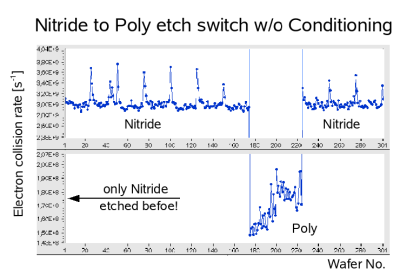
The collision rate shows a significant drift after switching to a
poly-Si etch process when a long time before nitride etch was processed
(and vice versa).- Use a continuous
switching between the different processes. The chamber is not
conditioned for poly and not for nitride etch, it is in a stable
in-between stage. In this special case the chamber wall state leads to
a very effective operating mode.
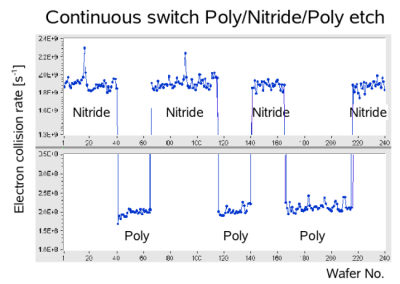
In the case of continuous switching between poly-Si and nitride etch processes there is no drift of the collision rate.
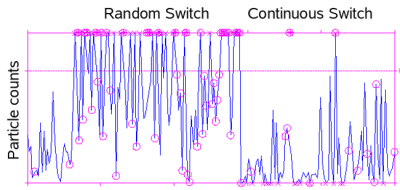
The chamber, conditioned for poly or nitride etch generates particles if the process is changed.
The continuous switching between the processes generate much less particles.
|
| Measure |
In this special case the continuous switch between the processes improve the process stability and the yield. |
| Benefit |
Better process stability, longer MTBC, and less particle problems. |
| |