
| Arcing at e-chuck | |||||
| Material | Processes | ||||
| Supplier | Chamber Principle | MERIE | |||
| Topic | FDC | Chamber Hardware | |||
| Reference | A. Steinbach, Infineon Technologies Dresden, et al.: 'Monitoring of Process Stability and Chamber Matching by Plasma Parameter Measurement using High-speed SEERS', 4th European Advanced Equipment Control / Advanced Process Control (AEC/APC) Conference, Grenoble, France, 2003.  |
||||
| Problem | Plasma processes with additional magnetic fields tend to arcing. | ||||
| Effect |
If not detected early, arcing causes erosion of anaodization at the chamber and generates particle. Arcing is basically a breakthrough in an insulating layer at the chamber wall, where ever potential grown-up. Reasons for arcing are:
Effect on wafer / process: Hardware related effect: Effect on plasma parameters: The plasma density is sharply decreased for short times. Collision rate:
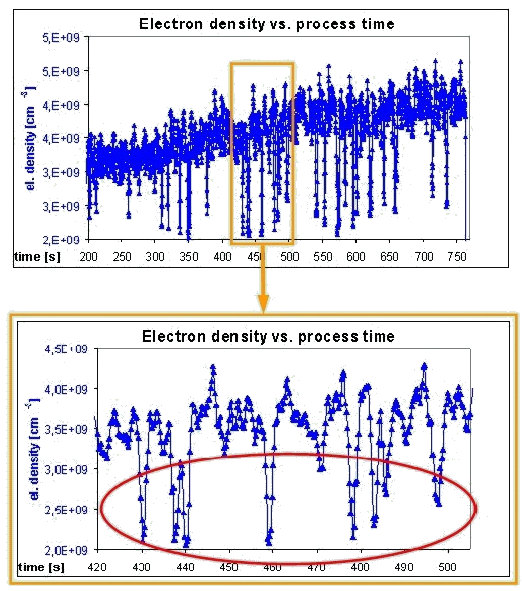
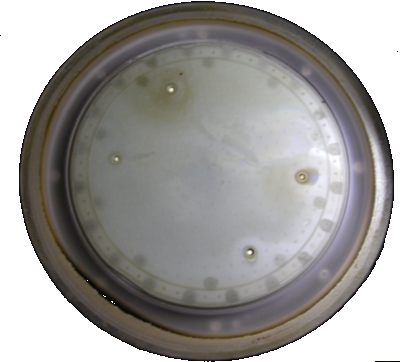
The plasma instabilities in the diagram above (red) indicate arcing at the e-chuck. Erosion of the anaodization near the lift pin holes are shown in the picture below.
|
||||
| Measure |
Open the chamber and remove defect chamber parts. Realize a good grounding of all chamber parts. |
||||
| Benefit | Lower maintenance costs (spare part) and reduced particle genaration. |
||||